

 Back
Back
ARISA workshops across Europe: Connecting European vision with local action

Author: Wiktoria Orlowska, DIGITALEUROPE
To support the wide uptake of ARISA’s outcomes, partners across Europe have been engaging national stakeholders through a series of local workshops. These events were designed to connect European-level initiatives with national and regional realities, highlighting the practical value of ARISA’s resources for education, industry, and policymaking.
Between March and August 2025, 13 workshops took place in 13 countries – including Slovenia, Italy, Germany, Hungary, Spain, Poland, Ireland, Greece, the Netherlands, Ukraine, Belgium, France, and Estonia – bringing together over 620 participants. Each event offered a space for dialogue, learning, and collaboration on the future of AI skills in Europe.
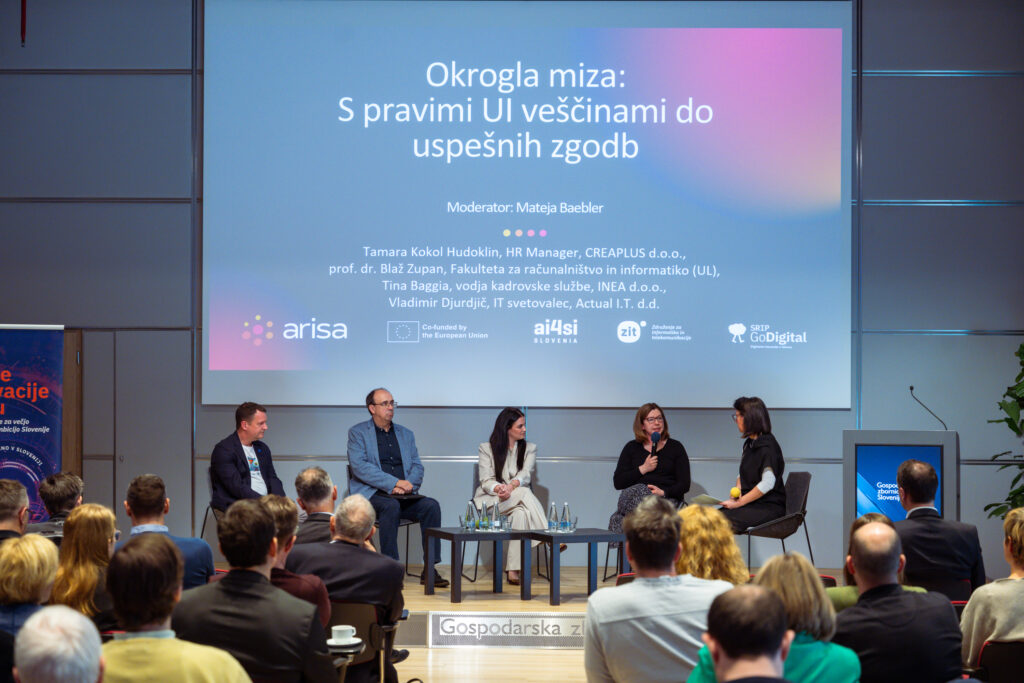
Photo from the ARISA event in Slovenia
What we heard: Key themes from national conversations
Across countries and sectors, several recurring themes emerged from the workshops:
- Urgent demand for AI-related upskilling and reskilling, particularly within SMEs, education providers, and public sector bodies;
- Gaps in AI-related educational content, including the need for stronger integration of ethics, governance, and sector-specific application;
- Interest in modular, micro-credential-based learning, with institutions and businesses alike seeking flexible, practical, and certifiable training pathways;
- Desire for stronger university–industry cooperation, as well as for national or European platforms to support peer learning and resource sharing;
- Recognition of ARISA’s outputs as timely and highly relevant, especially the Core Curricula, AI Skills Academy, and ARISA Quality Label.

Photo from the ARISA event in Slovenia
From policy to practice: National priorities and focus areas
Each country brought its own perspective on AI skills development:
- In Slovenia, Italy, France, and Greece, the focus was on AI workforce development and upskilling strategies.
- In Germany, Spain, Poland, and Ukraine, discussions centred around higher education reform, ethical frameworks, and curricular innovation.
- Hungary, Ireland, the Netherlands, and Estonia highlighted opportunities for industry–academia collaboration, the use of micro-credentials, and data-centric training models.
- In Belgium, Ireland, and Germany, the conversation turned to policy and certification, with strong recommendations around harmonisation, funding models, and public–private partnerships.

Photo from the ARISA event in Hungary
Outcomes and future directions
The workshops generated several actionable insights and pathways to support the long-term adoption and sustainability of ARISA outcomes:
- Focusing on knowledge transfer by producing practical guides, training materials, and implementation support to enable other organisations to build on ARISA’s work after the project ends.
- Integrating ARISA resources—such as the Core Curricula, Train-the-Trainer materials, and the AI Skills Academy—into national education systems, vocational training, and digital upskilling strategies.
- Piloting ARISA tools in real-world settings, such as intern training in Ireland, internal company upskilling in Slovenia, and proposed programmes for civil servants in Poland.
- Growing the ARISA community by expanding Associated Partnerships, sharing best practices, and anchoring collaboration through platforms like the AI Academy and the Career Guidance tool.
- Engaging with policymakers to secure recognition of ARISA’s micro-credentials and support alignment with national strategies and EU frameworks such as ESCO and EQF.

Photo from the ARISA event in Hungary
Building momentum for the future
The local workshops have played a key role in strengthening ARISA’s network, validating its outputs, and setting the stage for long-term impact. They helped build new partnerships, identified national champions, and brought the project closer to the communities it aims to serve.
With one year remaining in the project, the insights, relationships, and use cases developed through these workshops will be essential to ensuring that ARISA continues to empower organisations and individuals across Europe – long after the project officially ends.
Project partners

Other interesting news

ARISA Newsletter: December 2025
19 December 2025
This December newsletter offers you a quick recap of our activities and project highlights over the past three months.

AI and Cybersecurity: Addressing risks and opportunities through the ARISA project
23 October 2024
As artificial intelligence (AI) continues to transform industries, its adoption into various sectors brings new cybersecurity challenges. The ARISA project, dedicated to enhancing AI skills across Europe, recognises this critical intersection. Cybersecurity is integrated into the project’s curricula, equipping participants not only with AI expertise but also with the vital knowledge to mitigate security risks posed by AI advancements.

ARISA Newsletter: June 2025
30 June 2025
ARISA Newsletter: June 2025
