

 Back
Back
EU project ARISA to fast-track the AI upskilling and reskilling in Europe

PRESS RELEASE / 19 Jan 2023
Twenty leading organisations drive the Artificial Intelligence Skills Alliance (ARISA) project to accelerate the upskilling and reskilling of employees, job seekers, business leaders, and policymakers into AI-related professions.
Artificial Intelligence’s (AI) transformative potential opens Europe to new opportunities, from process automation to talent development. AI technologies could significantly impact industries such as finance, healthcare, supply chains, manufacturing, or education.
Today, in the European Union, only 8% of enterprises are using an AI technology[1]. One of the biggest barriers to AI adoption within organisations is the lack of skills[2]. ARISA, an Erasmus+ project led by DIGITALEUROPE, intends to reduce the AI skills gap, boosting AI uptake and its benefits for society.
ARISA proposes a skills development approach to ensure a human-centric and trustworthy AI

Foundational and technical knowledge and skills in AI are paramount to ensure people and businesses can use and design trustworthy AI-based services and solutions, with major benefits to the digital ecosystem and the whole of society.
ARISA aims to reduce the AI skills shortages in the EU market by identifying the current and emerging AI skills gaps for specific occupational domains, including business leaders, technology leaders, tech practitioners, and policymakers. The ARISA Needs Analysis report (coming in early 2023) will uncover the new market requirements in terms of roles and skills for AI-related professions.
Over the four years of the project (2022-2026), ARISA will develop a European strategy for AI skills development that defines concrete strategic objectives and actions to address the identified skills gaps including a short-term and long-term roadmap. The project will also deliver curricula and learning programmes (EQF 4-8) to empower employees, job seekers, business leaders, and policymakers with the knowledge and skills needed to support an inclusive and human-centric AI.
An open and collaborative AI skills community to leave no one behind
ARISA is designed to engage with public and private stakeholders at the local and European levels to ensure the highest quality results and support the AI upskilling and reskilling of the workforce. Ultimately, the project wants to foster a community revolving around AI skills as part of the European Commission’s flagship initiative Pact for Skills.
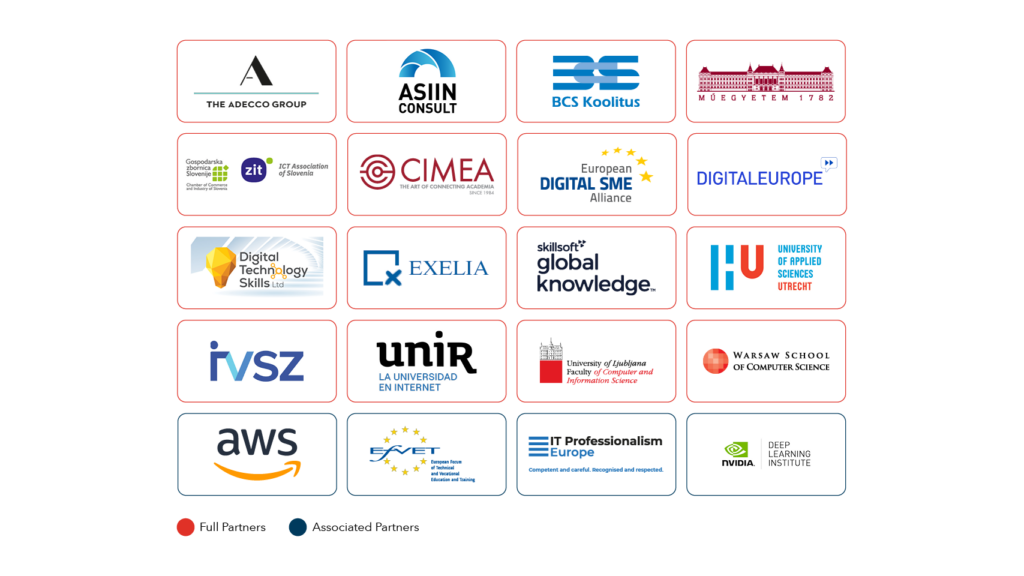
Coordinated by DIGITALEUROPE, the ARISA consortium brings together 16 full partners and 4 associated partners with solid experience in technology, training, and community building, a wide network of stakeholders from diverse backgrounds including education and training providers, qualification bodies and associations representing the industry and digital ecosystem.
[1] European Commission, Digital Economy and Society Index 2022
[2] IBM, Global AI Adoption Index 2022
Other interesting news
ARISA Newsletter: February 2024
29 February 2024
How to position Europe at the forefront of AI development? Addressing the growing demand for AI skills is crucial. Our recently published AI Skills Strategy for Europe presents concrete solutions to bridge the AI skills gap, retain talent and ensure diversification of AI profiles.

ARISA launches the AI Skills Strategy for Europe
23 January 2024
Press Release • ARISA has unveiled an innovative strategy aimed at addressing this surging demand and mitigating the skills gaps and mismatches in the AI landscape across Europe.

Webinar wrap-up! AI and the Future of Learning: Key Factors for Success
23 September 2024
On 19th of September 2024, the Artificial Intelligence Skills Alliance (ARISA) organized the AI and the Future of Learning: Key Factors for Success webinar, bringing together educators, industry experts, and members of the ARISA community to explore the transformative potential of artificial intelligence (AI) in the educational landscape. The discussion highlighted critical insights on ethical considerations, the integration of AI into learning environments, and the evolving roles of educators and institutions. Here are some highlights of the fireside chat on Using AI to enhance, and not replace, learning
