

 Back
ARISA Newsletter: November 2023

IN THE LIMELIGHT
Do you want to get involved in the ARISA project? Become our Associated Partner and help us share the future of AI skills in Europe!
By becoming an ARISA Associated Partner, your organisation gains access to a vibrant network that fosters knowledge exchange, collaboration, and the collective pursuit of excellence in AI skills development. We offer you the flexibility to choose where to contribute so it aligns better with your organisation’s goals. Sounds interesting? Read more about the Associated Partnership opportunity & apply.
FEATURED
ARISA is officially a partnership under the Digital Large-Scale Partnership of the Pact for Skills. The Pact for Skills is one of the flagship actions of the European Skills Agenda. In November 2023, ARISA has officially become a partnership under the Digital Large-Scale Partnership of the Pact for Skills. Read more.
UPDATES CORNER
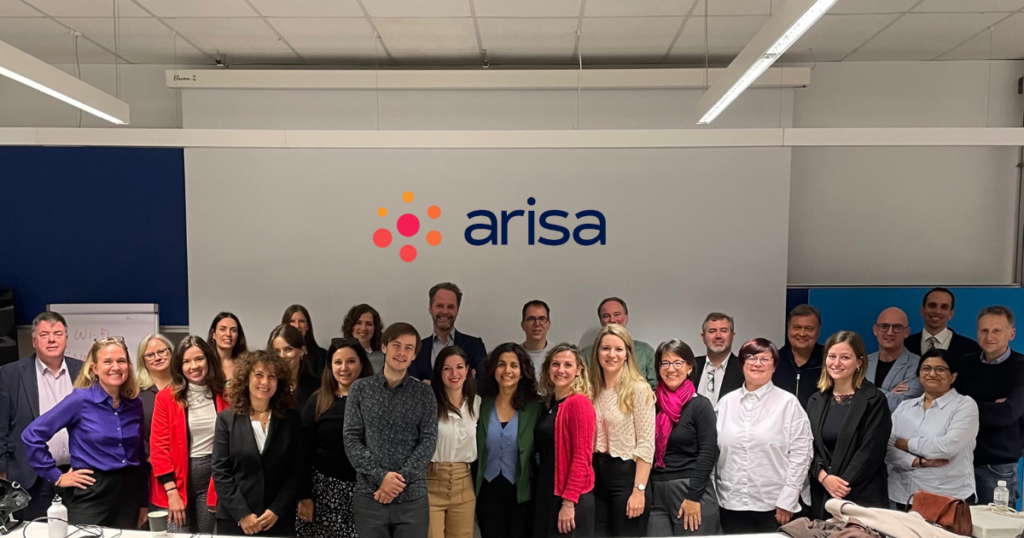
In November, the ARISA Consortium met in Madrid. We discussed our ongoing activities, such as the development of innovative AI curricula & learning programmes, which will contribute to bridging AI skills gaps in the EU and beyond.
UPCOMING EVENTS
- Use of skills intelligence tools to define upskilling and reskilling actions / 6 Dec 2023 / Online: This seminar will look at the topic of skills intelligence and how Pact for Skills members can benefit from producing and using skills intelligence to define upskilling and reskilling actions.
- Digital Europe Programme NEW Call: Info Day & Pitching Event / 12 Dec 2023 / Online: Are you a higher education institution, a research and excellence centre or an innovative business developing digital technologies? Join the Info Day event to learn more about the open calls for proposals and ask your questions in the related Q&A sessions!

GET FREE RESOURCES
- Analysis of relevant AI practices and initiatives. This report analyses a wide range of relevant initiatives on digital skills and AI skills from EU countries and beyond with the main aim of identifying what could be the success factors of the identified initiatives and what are the transferable elements to the European AI Skills Strategy.
- AI upskilling and reskilling: Key priorities & enablers. This report gathers stakeholders’ insights, good practices, and recommendations for the enhancement and validation of the general approach of the AI Skills Strategy for Europe. The outcomes of the report complement the conclusions of the AI Skills Needs Analysis.
- Europe’s Most Needed AI Skills and Roles. The 2023 AI Skills Needs Analysis report sheds light on the most needed AI roles and skills in Europe. The conclusions are drawn based on the study of job vacancies, labour market survey reports, available research on AI roles and skills, learning programmes, and databases.
Not a subscriber yet? Click here to subscribe to the ARISA Newsletter.
Other interesting news

Kharkiv National University of Radio Electronics joining the ARISA project
13 December 2024
The Artificial Intelligence Skills Alliance (ARISA), an EU-funded project coordinated by DIGITALEUROPE, is proud to announce the inclusion of Kharkiv National University of Radio Electronics (NURE) as a new partner. ARISA, which focuses on addressing the AI skills gap across Europe, is part of a broader mission to prepare the European workforce for a rapidly evolving digital future.
ARISA Newsletter: July 2023
27 July 2023
What are the most needed AI skills and roles in Europe? ARISA has recently released the AI Skills Needs Analysis report, which sheds light on the current and future skills demand in the field of AI.

Integrating AI learning into institutions: Lessons learned from the Budapest University of Technology and Economics
16 June 2026
The integration of cutting-edge AI education into traditional academic programmes is a challenge many universities face. It’s a fine balancing act between innovation with accreditation, theory with practice, and flexibility with structure. At the Budapest University of Technology and Economics (BME), the Faculty of Electrical Engineering and Informatics took on this challenge headfirst by piloting the ARISA project within its MSc in Computer Engineering programme. What results is a successful, scalable model for embedding industry-relevant AI skills into formal higher education. In this interview, Dr. Bálint Gyires-Tóth at BME develops on the university’s journey from planning to implementation and refinement. How did BME align ARISA’s modular learning outcomes with its existing curriculum? What lessons emerged? How can the experience be replicated for institutions ready to integrate AI learning in their courses/training? With over 400 students participating across two pilot rounds, BME’s story offers valuable insights into the scalability and effectiveness of integrating industry-relevant AI competencies into formal academic programmes.
